

No band is more deeply woven into the story of blotter art than the Grateful Dead. The imagery, the culture, the collectors — even the man who ran their sound system — all connect the Dead to perforated paper in ways no other band can claim.
This is the visual history of Grateful Dead blotter art: where it came from, why the iconography endures, and how a Jerry Garcia blotter print ended up in the permanent collection of the Rock & Roll Hall of Fame.
Where the Dead and Blotter Paper First Crossed Paths
You can't tell the story of blotter art without the Grateful Dead, because the two grew up in the same house.
The Dead emerged from the mid-1960s San Francisco scene as the de facto house band of Ken Kesey's Acid Tests — the freeform happenings that fused music, light shows, and psychedelic experience into a single event. And the man behind the band's legendary early sound system, Owsley "Bear" Stanley, was also the underground's most famous LSD chemist. The band's culture, its audience, and psychedelic paper were intertwined from the very first note.
As perforated blotter paper became the standard format in the 1970s, the images printed on those sheets drew from the visual language fans already knew: skeletons, roses, lightning bolts, dancing bears. Dead iconography became blotter iconography — first in the underground, and later, in a twist nobody saw coming, in galleries and museums.
The Icons: Why Dead Imagery Rules Blotter Art
A few visual motifs dominate Grateful Dead blotter art, and each carries its own story:
The Steal Your Face skull. The lightning-bolt skull — originally a stencil Owsley and Bob Thomas devised to mark the band's equipment — became the single most recognizable mark in Dead iconography. On a perforated grid, its bold symmetry is practically made for the format.
Dancing bears. The marching bears associated with Bear Stanley are probably the most beloved (and most bootlegged) image in the entire blotter canon. Vintage dancing-bear sheets are among the most sought-after blotter collectibles in existence.
Skeletons and roses. Drawn from the band's album art lineage — itself borrowed from Edward Sullivan's 19th-century Rubáiyát illustrations by way of artists Stanley Mouse and Alton Kelley — the skeleton-and-rose motif ties blotter art directly to the golden age of San Francisco poster art.
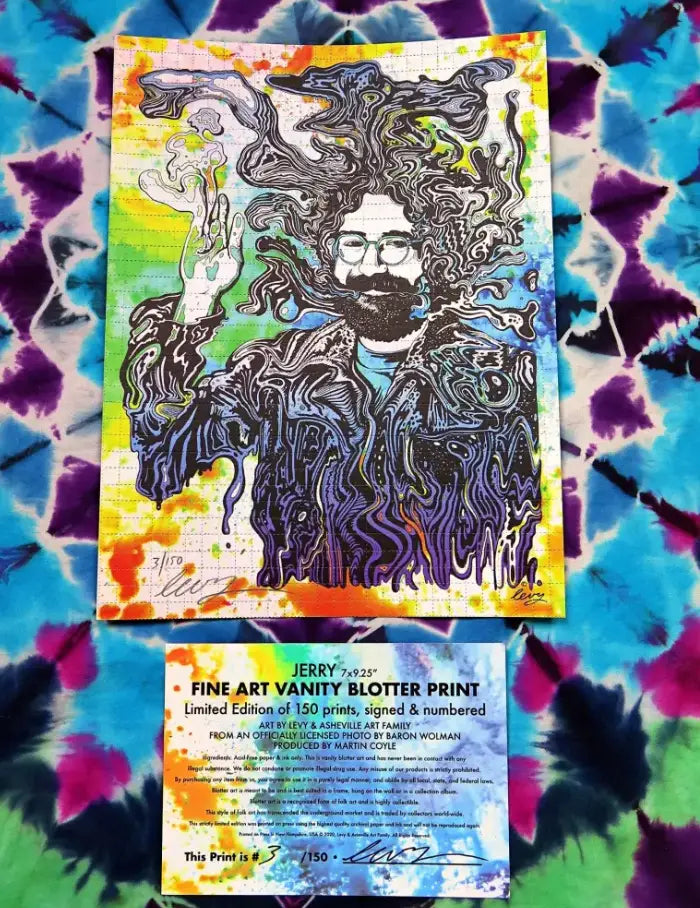
Jerry. Portraits of Jerry Garcia, especially after his passing in 1995, became a genre of their own: tributes, memorials, and fine art editions that treat Garcia the way earlier generations treated saints on devotional prints.
Here's the thing collectors quickly learn: most vintage Dead-imagery blotter was unauthorized folk art — anonymous printers borrowing the band's symbols because those symbols were the culture. That outlaw provenance is part of what makes vintage sheets fascinating. But it's also what makes the next chapter remarkable.
From the Parking Lot to the Permanent Collection
For decades, Dead blotter art lived in Shakedown Street parking lots, shoebox collections, and the archives of preservationists like Mark McCloud, whose San Francisco Institute of Illegal Images treats blotter as the cultural record it is.
Then the institutions caught up.
Today, a Jerry Garcia blotter art print resides in the permanent collection of the Rock & Roll Hall of Fame — a piece we're proud to say came out of our studio, created in collaboration with artist Joshua Marc Levy and built around photography by the legendary Baron Wolman, Rolling Stone's first chief photographer. The same museum that enshrined the Grateful Dead as inductees in 1994 now preserves blotter art as part of the band's visual legacy.
Think about that arc: an art form born in the underground, printed anonymously, traded hand to hand — now archived alongside gold records and stage gear. Grateful Dead blotter art didn't just survive the culture that created it. It became one of the ways that culture is remembered.
Collecting Grateful Dead Blotter Art Today
Whether you're a Deadhead first or a print collector first, here's what to know:
Vintage sheets (1970s–1990s) are historical artifacts — usually anonymous, often crudely printed, and valued precisely for that authenticity. Provenance is everything; sheets with documented history from known collections command the strongest prices.
Contemporary fine art editions are where the format lives now: offset-printed on archival stock, letterpress-perforated, released in numbered editions, and often hand-signed by the artist. Signed, limited editions are the pieces that have historically appreciated — the same dynamic that drives the rock poster market.
Quality matters more than ever. As Dead-themed blotter has grown popular, so have low-effort knockoffs — inkjet prints with glossy coatings and sloppy or missing perforations. Real blotter art is a printmaking craft: flat, matte, archival paper, crisp die-cut perforation you can feel. (We covered the full checklist in our guide to spotting fake and low-quality blotter art.)
Display it like the art it is. A framed square of Dead blotter — dancing bears in a float mount — is one of the great conversation pieces in music collecting.
Frequently Asked Questions
Is Grateful Dead blotter art legal to buy and collect? Yes. Undipped blotter art is fine art — ink on perforated paper — and is legal to buy, sell, frame, and collect. It's sold openly and held in museum collections.
What is the most collectible Grateful Dead blotter art? Vintage dancing bear and Steal Your Face sheets with documented provenance, and signed limited editions by known artists. Tribute editions connected to Jerry Garcia are perennially in demand.
Why are dancing bears on blotter art? The marching bears are tied to Owsley "Bear" Stanley, the Dead's early soundman and patron. The bears became shorthand for the entire psychedelic side of Dead culture, making them a natural fit for the blotter format.
Is there Grateful Dead blotter art in any museums? Yes — a Jerry Garcia blotter print produced by our studio with artist Joshua Marc Levy, featuring Baron Wolman photography, is in the Rock & Roll Hall of Fame's permanent collection. Mark McCloud's Institute of Illegal Images in San Francisco also preserves decades of Dead-related sheets.
Do you sell Grateful Dead–inspired blotter art? We produce and carry psychedelic and Dead-culture-inspired fine art blotter editions, printed on our Heidelberg offset press and letterpress-perforated in-house, the traditional way — since 2012.
Keep Truckin'
Grateful Dead blotter art is where American music history, psychedelic culture, and printmaking craft meet on a single square of paper. Few collectibles carry that much story in seven and a half inches.
Shop our blotter art prints for sale → — limited edition, artist-signed sheets printed and perforated in-house.
Commission custom blotter art → — your artwork, offset-printed and letterpress-perforated the traditional way.
Or dive deeper with our complete guide to blotter art history, collecting, and buying.