

Blotter art has been a cornerstone of psychedelic culture since the 1960s, but most people have no idea how it's actually made — or how to tell the difference between a collectible-grade print and a cheap knockoff. Whether you're a first-time buyer or a seasoned collector, understanding the production process is the best way to protect your investment and appreciate what separates genuine blotter art from the flood of low-quality prints hitting the market.
What Is Blotter Art Made From?
Authentic blotter art starts with the paper. Traditional blotter paper is a highly absorbent, untreated stock — the same material that has been used in the underground since the earliest days of psychedelic culture. It has a distinctive matte, slightly textured surface that takes ink differently than standard art paper, which is part of what gives quality blotter art its characteristic look and feel.
The paper is uncoated by design. That matters more than most buyers realize.
The Printing Process: Offset Lithography vs. Inkjet
This is where quality diverges sharply — and where BlotterArt.io does things differently than most.
At BlotterArt.io, every print is produced using traditional offset printing methods. Offset lithography transfers ink from a plate to a rubber blanket and then onto the paper, delivering sharp, accurate color reproduction with ink that absorbs into the stock rather than sitting on top of it. The result is a print that looks exactly as it should: rich, flat, and matte — with no sheen, no gloss, and no compromise.
Contrast that with what a lot of so-called blotter art producers are cranking out today. Inkjet printing — especially consumer-grade inkjet — lays ink on top of the paper rather than into it. On uncoated blotter stock, this produces a surface that can appear almost glossy or plastic-coated. It looks wrong immediately to anyone who knows what authentic blotter art is supposed to look like. The colors are often oversaturated, the ink sits raised on the surface, and the prints have no archival longevity.
If your blotter art looks like it has a glossy coat, that's not a feature. That's a red flag.
Perforation: The Letterpress Step Most Producers Skip
After printing, authentic blotter art is perforated. At BlotterArt.io, this is done on a letterpress — the traditional, mechanical method that produces clean, consistent perforations across the entire sheet.
Letterpress perforation creates the precise grid of holes that defines the look of blotter art and allows individual tabs to be separated cleanly. It's a separate production step that requires dedicated equipment and expertise. Many budget producers either skip perforation entirely, use low-grade die-cutting machinery, or produce perforations that are inconsistent, misaligned, or prone to tearing.
After perforation, sheets are trimmed to size — a final step that gives each piece its clean, finished edges and consistent dimensions. It's a detail that matters when you're framing, displaying, or sleeving a piece for a collection.
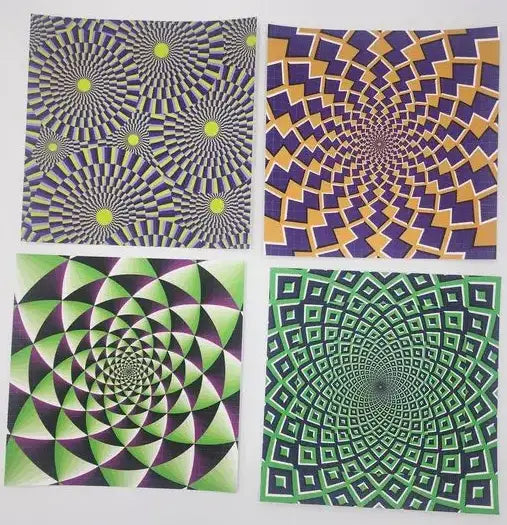
Blotter Art Formats: Bordered vs. Borderless
Not all blotter art is configured the same way, and the format often signals the intent of the edition.
Traditional borderless blotter art covers the entire sheet edge to edge with the printed image. This is the classic format — clean, graphic, and true to the underground origins of the medium.
Bordered blotter art includes a margin around the printed image — intentional white space that exists for a reason. Borders are typically reserved for artist-signed limited editions, where the margin provides space for the artist's signature, an edition number, and sometimes a title or certificate notation. These are the pieces produced in controlled quantities, authenticated by hand, and treated as fine art multiples rather than open editions.
Blank Blotter Art: For Artists Who Want to Make Their Own
Not every sheet needs an image. Blank blotter art — unprinted, perforated blotter paper — is its own category, and it's one of the most requested items we produce.
The appeal is simple: everything hard about making blotter art happens before the artwork ever touches the sheet. Sourcing authentic uncoated blotter stock, perforating it cleanly on a letterpress, trimming it square — that's the part you can't fake with a craft knife and a tracing wheel. Blank sheets give artists, printmakers, and DIY makers a genuine foundation to work on, whether you're hand-drawing a one-of-one, screenprinting a small run, or experimenting with your first design.
Our blanks are the same stock and the same perforation as our artist editions. Same paper, same letterpress perf, same clean trim — just waiting for your art.
👉 Shop Blank Blotter Art — perforated sheets ready for your design
Why Artist-Signed Editions Appreciate in Value
Of all the blotter art in the secondary market, artist-signed limited editions are consistently the pieces that appreciate over time.
The reasons are straightforward: scarcity, authentication, and provenance. A signed, numbered edition — especially one from an established artist — is a documented, finite object. The signature connects the piece to a specific person and moment. The edition number tells a collector exactly how rare it is. These are the same factors that drive value in any fine art print market, from screenprints to etchings.
Unsigned open-edition blotter art can still be desirable and collectible, but it doesn't carry the same investment potential. If you're buying blotter art with an eye toward long-term value, signed limited editions are where to focus.
The AI Art Problem in Blotter Art
There's another issue worth naming directly: a growing number of blotter art sellers are using AI-generated imagery.
BlotterArt.io does not use AI art. Every design in our catalog comes from a real artist.
This matters for a few reasons. AI-generated imagery has no provenance — there's no artist, no studio practice, no story behind the image. In a collecting category where authenticity and artistic lineage are central to value, AI art is a dead end. It also tends to look a certain way: technically competent but aesthetically hollow, with none of the intentionality that makes blotter art worth owning in the first place.
When you're buying from BlotterArt.io, you're buying work made by human artists using real production methods. That's not a small thing.
How to Spot Low-Quality Blotter Art
Before you buy from anyone, here's what to look for:
- Glossy or coated appearance — authentic blotter art is matte. Gloss means inkjet.
- No perforation or inconsistent perforations — sloppy holes, misaligned grids, or perforations that tear rather than separate cleanly.
- AI-generated imagery — if the art looks algorithmically generated, it probably is.
- No edition information — legitimate limited editions come with numbering and, for signed pieces, authentication.
- Vague production claims — if a seller can't tell you how their prints are made, that tells you something.
The BlotterArt.io Standard
BlotterArt.io has been producing and selling blotter art since 2012. Every piece we carry is printed using traditional offset lithography on authentic blotter stock, perforated on a letterpress, and trimmed to size. We work with real artists — no AI, no inkjet, no shortcuts.
If you want to go deeper on the history, culture, and collecting side of blotter art, our complete guide covers everything: 👉 What Is Blotter Art? A Complete Guide to History, Collecting & Buying
And if you're interested in custom blotter art production for your project, event, or edition: 👉 Custom Blotter Art Production — BlotterArt.io