

How to Spot Fake or Low-Quality Blotter Art Prints
Whether you're a seasoned collector or just discovering the world of psychedelic art, knowing how to evaluate blotter art quality is essential before you buy. Here's what separates authentic, well-crafted pieces from cheap knockoffs.
What Is Blotter Art, and Why Does Quality Matter?
Blotter art sits at a unique crossroads of counterculture history, fine art printmaking, and collectible culture. These small, perforated sheets — originally associated with the early psychedelic era — have evolved into a legitimate and highly collectible art form, with original editions from acclaimed artists fetching serious prices on the secondary market.
But not all blotter art is created equal. As demand has grown, so has the number of poorly made prints flooding the market. For collectors, the difference between a quality piece and a substandard one isn't just aesthetic — it affects value, longevity, and authenticity.
If you're new to the space, our complete guide to blotter art history and collecting is the best place to start before diving into what to look for when evaluating a piece.
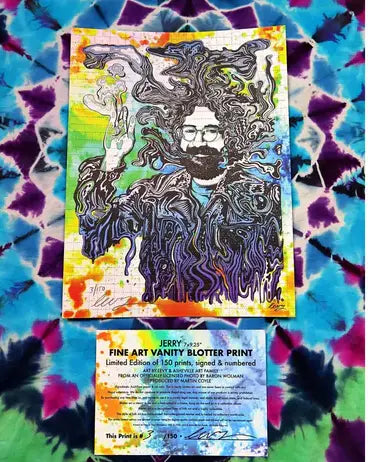
1. Examine the Die-Cut Perforations
The single most telling sign of quality blotter art is the perforations — the small dots punched through the sheet that divide it into individual "tabs."
Authentic, professionally produced blotter art is made using a die-cutting process, where a precision tool stamps clean, consistent holes through the paper at uniform intervals. Here's what to look for:
Signs of quality die-cutting:
- Perforations are perfectly uniform in size and spacing across the entire sheet
- Holes are clean-punched with no tearing, fraying, or ragged edges
- The grid is straight and evenly aligned from edge to edge
- Tabs separate cleanly without tearing the artwork when pulled apart
Red flags:
- Irregular or misaligned perforations
- Holes that are inconsistent in size
- Tearing or paper fuzz around the perforation holes
- A grid that drifts or skews toward the edges of the sheet
Sloppy perforations are one of the most common signs that a piece was produced cheaply or without proper equipment. A legitimate producer invests in precision tooling — the perforations should look as intentional and refined as the artwork itself.
2. Assess the Print Quality
Blotter art is printed before it's perforated, and the printing quality speaks volumes about the overall production standard.
What good print quality looks like:
- Sharp, crisp lines with no bleeding or blurring
- Vibrant, consistent color saturation across the full sheet
- No streaking, banding, or ink pooling
- Registration is tight — meaning multi-color artwork lines up precisely
Warning signs:
- Faded or washed-out colors
- Blurry or soft edges on line work
- Visible banding or streaks (signs of a low-quality inkjet printer)
- Colors that shift or vary across different areas of the same sheet
- Ink that smears when touched
High-quality blotter art is typically produced using archival inks on appropriate paper stock. If the colors look dull in hand or the ink feels tacky, that's a problem.
3. Check the Paper Stock
The paper used in blotter art matters more than most buyers realize. Traditional blotter paper has a distinctive texture — slightly absorbent, with a specific weight and feel that experienced collectors recognize immediately.
Quality indicators:
- Appropriate thickness and weight — not too thin or flimsy
- Consistent texture across the sheet
- Paper that holds ink cleanly without bleed-through to the back
- No warping, buckling, or moisture damage
Problematic signs:
- Paper that feels like standard copy paper or photo paper
- Excessive bleed-through visible on the reverse side
- Thin, cheap stock that doesn't hold its shape
- Yellowing or brittleness (signs of non-archival materials)
Some sellers pass off prints on cheap inkjet paper as "blotter art." The paper stock is a dead giveaway if you know what authentic blotter paper feels like.
4. Look for Artist Authentication
For collectible editions — especially signed or numbered pieces — authentication is everything. The value of artist-signed blotter art comes entirely from its verifiable provenance.
Authentic authentication includes:
- Hand-signed by the artist — look for a genuine signature, not a printed one. A printed signature will look perfectly uniform and slightly raised under magnification. A real signature will show natural variation in pen pressure and line weight.
- Edition numbering — legitimate limited editions are numbered (e.g., 42/100), typically in pencil or pen in the artist's hand
- Certificate of authenticity — reputable galleries and producers provide COAs for signed editions
- Provenance documentation — where did the piece come from? A purchase from a known gallery or directly from the artist carries far more weight than an anonymous eBay listing
Red flags for forgeries:
- Signatures that look printed or screen-printed rather than hand-drawn
- Edition numbers that are typed or stamped
- No documentation of origin
- Sellers who can't or won't provide provenance information
5. Research the Source
Who produced the piece, and where did it come from? This is often the most important question a collector can ask.
The blotter art market is small enough that reputable producers and galleries are well-known within the community. Buying from established sources — galleries that work directly with artists, producers with a documented track record, or well-known collectors — dramatically reduces your risk of ending up with a fake or low-quality piece.
Questions to ask before buying:
- Is this piece produced and sold by an authorized gallery or the artist directly?
- Is there documented print run information?
- Does the seller have a verifiable history with the blotter art community?
- Are there reviews or community references you can check?
6. Be Skeptical of Unusually Low Prices
Quality blotter art — properly produced with good paper, precision die-cutting, archival inks, and artist authentication — costs money to make. If a piece is priced dramatically below what you'd expect for a comparable item from a known source, ask yourself why.
Authentic limited-edition signed pieces from established artists hold and often appreciate in value. Cheap knockoffs don't — and they don't deserve to share shelf space with the real thing.
Want Custom Blotter Art Produced the Right Way?
At BlotterArt.io, we've been producing blotter art since 2012 — and we do it properly. That means precision die-cutting, quality paper stock, archival inks, and meticulous attention to every sheet that leaves our facility.
If you're an artist, event promoter, brand, or collector looking to produce your own custom blotter art edition, we handle the entire production process from print to perforation.
Every custom run we produce reflects the same standards we apply to our artist editions — because blotter art is worth doing right.
Final Thoughts
Collecting blotter art is one of the most rewarding niches in the psychedelic art world, but only if you know what you're looking at. The key markers — clean die-cut perforations, sharp printing, quality paper stock, verified artist signatures, and trustworthy sourcing — are the same regardless of the artist or edition.
When in doubt, buy from known sources, ask questions, and trust your instincts. A well-made piece of blotter art should feel as considered and precise as any fine art print. Anything less isn't living up to the medium's legacy.
Want to learn more about the history, culture, and collecting of blotter art? Read our complete guide: What Is Blotter Art? →