

You find a blotter art print you love. There's a signed edition for three times the price. Is it worth it?
It's one of the most common questions new collectors ask — and the answer is more nuanced than a simple yes or no. Whether a signature meaningfully affects value depends on the artist, the edition size, and what you actually want from collecting blotter art. Here's how to think through it.
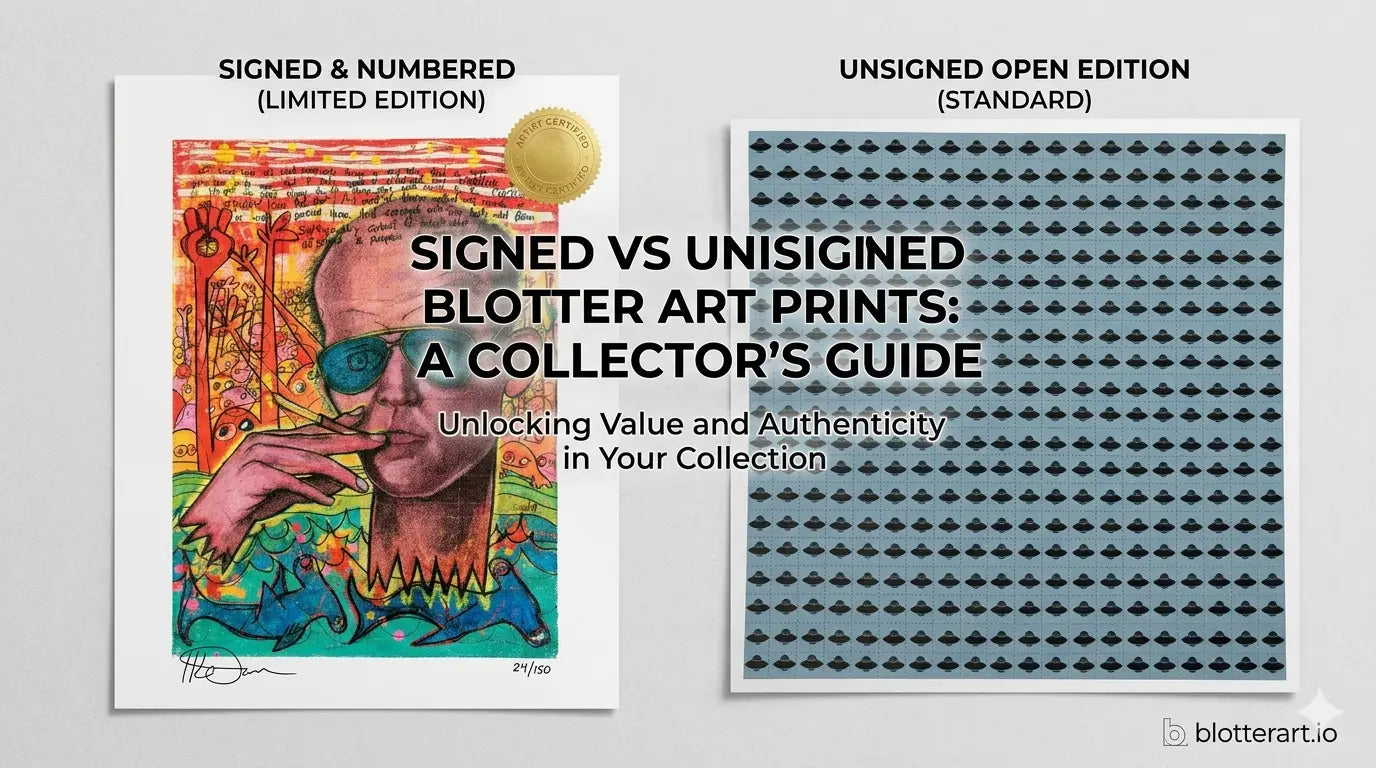
What "Signed" Actually Means in Blotter Art
In blotter art, a signature almost always means the artist who created the visual artwork has signed the print by hand. That's it — simple, but important.
Most signed blotter art is signed in pencil, not ink. This is intentional. Pencil sits on top of the paper fibers rather than soaking into them, which means it's less likely to bleed, feather, or interact poorly with the substrate over time. If you see a blotter print signed in ballpoint pen or marker, that's not necessarily a red flag, but pencil is the traditional and preferred method for archival reasons.
Beyond the signature itself, pay attention to edition numbering. A signed print will typically include a hand-written fraction like 12/100, meaning it's the 12th print out of an edition of 100. Smaller edition sizes generally carry more value. You may also encounter:
- AP (Artist Proof) — Prints pulled during the proofing process, outside the main edition. Traditionally limited to around 10% of the edition size. APs are often considered more desirable by serious collectors.
- HC (Hors Commerce) — "Not for sale" in French. These are typically gifted to collaborators, galleries, or kept by the artist. They're rare and can command a premium when they do surface.
Why Signatures Add Value
The case for signed editions comes down to three things: provenance, scarcity, and connection. (If you're still getting familiar with blotter art as a collectible category, our complete guide to blotter art history and collecting is a good starting point before diving into the signed vs. unsigned question.)
Provenance is about being able to trace a work back to its source. A signature — especially when accompanied by a certificate of authenticity or purchased directly from a known seller — establishes a direct link between the print in your hands and the artist who made it. In a market where fakes exist, that chain of custody matters.
Scarcity is straightforward. Signed editions are almost always limited runs. An open unsigned edition might have no ceiling on how many prints exist. A signed edition of 50 is finite by definition.
Connection to the artist is harder to quantify but very real in the blotter art world. This is a niche rooted in community, counterculture, and personal relationships between artists, collectors, and the broader psychedelic art scene. Owning a signed print by an artist like Killer Acid or Chuck Sperry isn't just a financial asset — it's a tangible piece of that relationship. For many collectors, that's the whole point.
From a pure resale standpoint, signed limited editions also hold and appreciate more predictably than open unsigned runs, assuming the artist has an established reputation and the edition size is genuinely limited.
When Unsigned Prints Still Make Sense
Unsigned doesn't mean unworthy. There are plenty of situations where an unsigned print is the right buy.
Historically significant prints can carry real value regardless of signature. Early blotter art from the 1960s through the 1990s — particularly prints associated with figures like Mark McCloud or specific countercultural moments — can be meaningful collectibles whether signed or not. The historical context is the provenance.
Open editions and entry-level collecting serve a real purpose. If you're new to blotter art and want to start building a collection without a major investment, unsigned open editions let you get familiar with artists, formats, and condition standards before you start spending more. There's nothing wrong with this — most serious collectors started this way.
Artist prints where signing wasn't common practice are another case. Some artists, particularly those working in the earlier decades of blotter art, didn't sign their work as a standard practice. For those, unsigned is simply authentic to how the work was originally produced.
How to Verify a Signature Is Authentic
The blotter art market is small enough that outright forgeries are less common than in larger art markets — but they do exist, and it's worth knowing what to look for.
Buy from known sources. This is the single most important factor. Purchasing from established dealers, directly from artists, or from vetted auction platforms dramatically reduces your risk. At BlotterArt.io, every signed edition we carry is sourced with provenance in mind.
Look for a certificate of authenticity (COA). A good COA includes the artist's name, title of the work, edition number, year, and the seller or gallery that issued it. It's not foolproof — a COA is only as trustworthy as the issuer — but it's a meaningful signal.
Know what the artist's signature actually looks like. Most established blotter artists have enough of a public presence that examples of their authentic signatures exist online. Do a quick comparison before committing to a purchase.
Red flags to watch for:
- Signatures in ink or marker on prints that should be pencil-signed
- Edition numbering that doesn't match known runs for that print
- No provenance information whatsoever
- Prices that seem too good relative to the artist's market
What to Look For When Buying Either
Whether you're buying signed or unsigned, a few fundamentals apply across the board.
Condition is paramount. Blotter art is printed on paper — it fades, yellows, gets moisture damage, and picks up creases easily. Ask about storage history. Has the print been kept flat, away from light, in a stable environment? A signed print in poor condition is often worth less than an unsigned print in excellent condition.
Edition size matters more than people think. A signed edition of 500 is less meaningful than an unsigned edition of 25. Always ask about the total run.
Original packaging adds value. If a print comes in its original sleeve, envelope, or with original documentation, keep it. That packaging is part of the collectible.
Know your artist. In a niche market, reputation is everything. An artist with a decade of work, gallery shows, and an active collector base is a very different proposition than an unknown first release. Do your homework before spending serious money.
The Bottom Line
For most collectors, signed limited editions are worth the premium — assuming you're buying from a reputable source and the artist has an established reputation. The combination of scarcity, provenance, and direct connection to the artist makes signed prints a stronger long-term hold.
That said, unsigned prints have a real place in any collection. Historical prints, entry-level collecting, and open editions all serve legitimate purposes, and condition will always matter more than the presence or absence of a signature.
The best approach: buy what you love, verify your sources, and understand exactly what you're getting before you spend.
Browse our current selection of signed and unsigned blotter art prints at BlotterArt.io.