

Blotter art has come a long way from its underground roots. Today it hangs in galleries, sells at auction, and sits in the permanent collection of the Rock & Roll Hall of Fame. But if you're new to collecting — or you're looking at two similar prints and wondering why one costs $30 and the other $300 — you're probably asking the same question we hear all the time: what actually makes blotter art valuable?
After producing and collecting blotter art since 2012, here's what we've learned separates collectible blotter prints from wall filler.
1. Signed and Numbered Limited Editions
The single biggest driver of blotter art value is the same thing that drives value in any fine art print market: a signed and numbered limited edition.
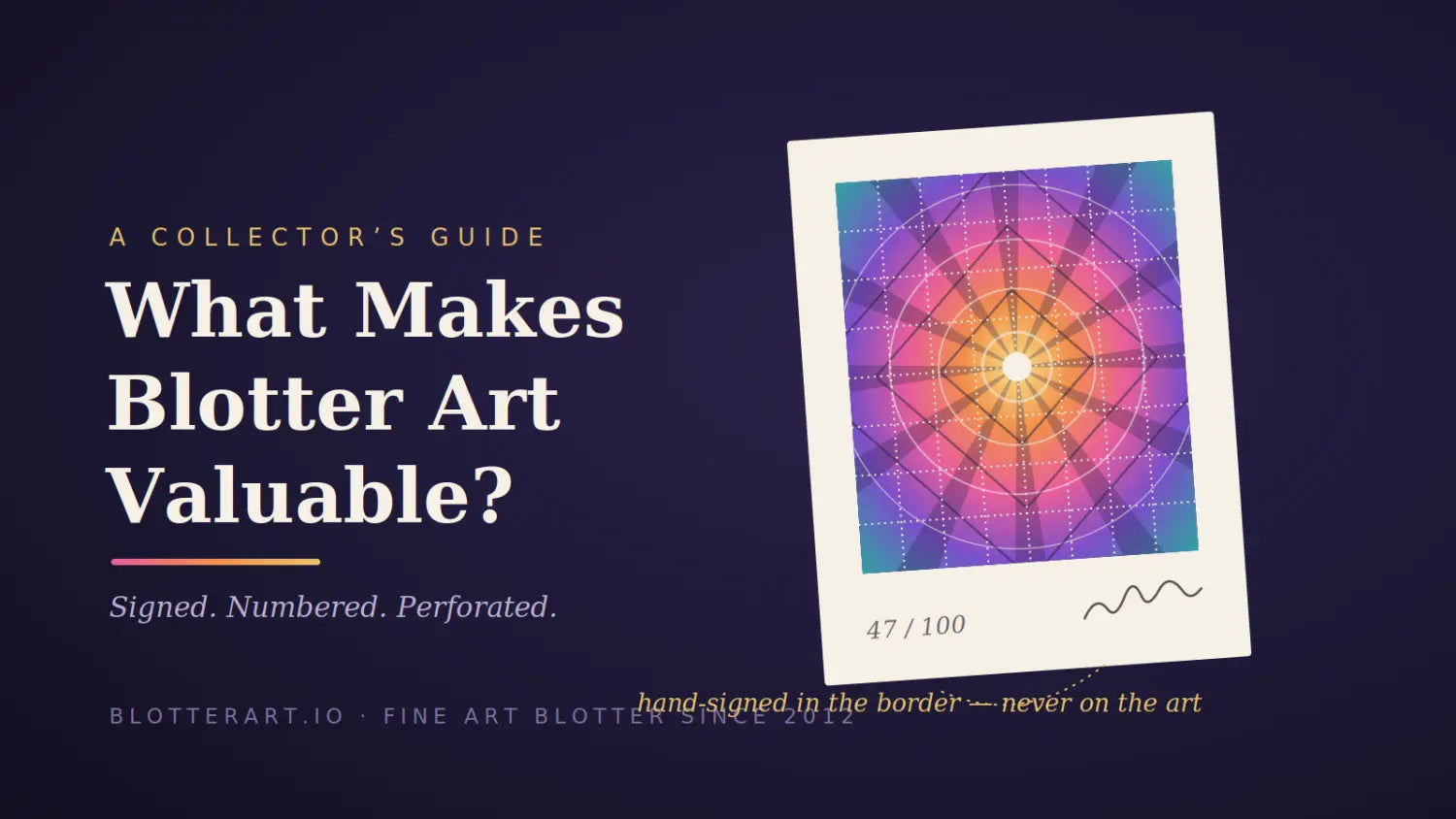
When an artist signs and numbers a blotter print — say, 47/100 — you know exactly how rare that piece is. The edition is capped. No more will ever be made. That scarcity is what allows a print to appreciate over time, and it's what serious collectors look for first.
Open editions, unsigned reprints, and mass-run sheets have no ceiling on supply — and without scarcity, there's no foundation for long-term value.
2. Where the Signature Goes Matters (More Than You'd Think)
Here's a detail many new collectors miss: a signature placed on the artwork itself can actually devalue the print.
In the fine art print world, the standard is a pencil or ink signature in the border — the clean margin surrounding the image. A border signature authenticates the piece while leaving the artwork untouched. A signature scrawled across the image area interferes with the art, and knowledgeable collectors treat it as a flaw, not a feature.
This is one of the reasons bordered blotter prints command a premium. The border isn't just aesthetic — it's the proper home for the artist's signature and the edition number, exactly like a traditional fine art print.
3. Borders: The Mark of a True Fine Art Blotter Print
Producing blotter art with a true border is harder than it looks. The perforation grid has to be registered precisely within the image area while leaving a clean, unperforated margin around it. It requires custom perforation dies and real press expertise — which is why very few blotter producers in the world can produce bordered blotter prints at all.
We're one of them. Every print we produce runs on a Heidelberg offset press with custom perforation dies on heavyweight archival cover stock, with clean borders ready for the artist's hand-signed signature and edition number.
When you see a perforated blotter print with a crisp border, a border signature, and an edition number, you're looking at a piece made the right way — and made to last.
4. Real Artists, Real Provenance
Blotter art value is also tied to who made it and where it came from. Prints by established blotter artists with documented bodies of work, gallery history, and collector followings hold value in a way anonymous designs never will.
Provenance matters too. A print purchased directly from the producing studio or the artist — with a known edition, known print run, and documented history — is worth more than the same image with no paper trail.
5. Beware of Mass-Produced and AI-Generated Blotter Art
A word of caution: some larger producers have started flooding the market with mass-produced, AI-generated designs — hundreds of interchangeable images cranked out with no artist, no edition limit, and no hand-signed authentication.
These sheets might look colorful in a listing photo, but to collectors they hold essentially no value. There's no scarcity, no provenance, no artist behind the work, and no reason for the market to ever care about them again after the sale. They're decoration, not collectibles.
If you want blotter art that holds its value: collect signed blotter art. Look for a real artist's name, a hand signature (in the border), an edition number, and a producer with a track record.
The Collector's Checklist
Before you buy, ask these questions. Is it a limited edition — signed and numbered by the artist? Is the signature in the border, not on the artwork? Is it genuinely perforated blotter stock, not just a paper print? Who is the artist, and do they have a real body of work? Who produced it, and can they document the edition? If the answer to all five is yes, you're looking at a piece with real collectible potential.
Start (or Grow) Your Collection
Shop Signed & Numbered Blotter Art Prints → Hand-signed, numbered limited editions from established blotter artists — printed with borders on our Heidelberg press.
New to the medium? Read: What Is Blotter Art? → The history, the culture, and how blotter became a collected art form.
Custom Blotter Art Production → Artists and brands: we produce signed, numbered, bordered blotter editions — one of the few studios in the world that can.
Questions About a Print or an Edition? Contact Us → We're happy to talk provenance, editions, and collecting.
BlotterArt.io has been producing fine art blotter prints since 2012. Our work with Joshua Levy and Baron Wolman is held in the permanent collection of the Rock & Roll Hall of Fame.